

Health
Breaking the flea life cycle
Keep your pet and your home flea-free by treating your pets and targeting places where fleas like to hide.
Share the article:
If you’ve had a flea infestation in your home, you’ll never want to have one again. To stop repeat infestations, you need to break the flea life cycle once and for all.
It’s a sobering thought that, for every flea on your dog or cat, there are probably at least nine more in your home. Adult fleas lay eggs that hatch into larvae and get everywhere — in carpets, between floorboards, in upholstery, and in your pet’s bedding.
So you might think you’ve accomplished getting rid of fleas, only to find a new generation emerging days to weeks after you’ve started treating your pet. This can be triggered by a change in temperature, for instance when you turn the central heating up.
To avoid such a nasty surprise, vets recommend using an oral or spot-on flea product year-round, such as BRAVECTO® to break the flea life cycle. This kills adult fleas on the pet and makes sure that newly hatched adult fleas that jump onto your pet are killed before they lay eggs. There are a number of such products available, and choosing the correct one for you and your pet is a decision that is best made through a discussion with your veterinarian.
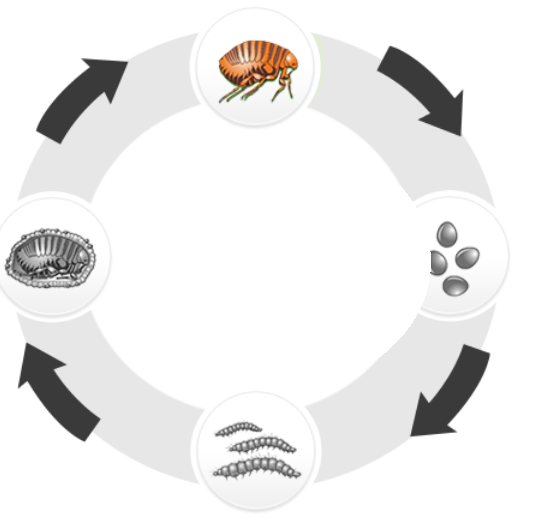
Adult Flea:
Starts feeding within 5 minutes. Females can ingest 15 times their body weight in blood. Mate 4 to 48 hours after feeding. Prefer to stay on host animal for life.
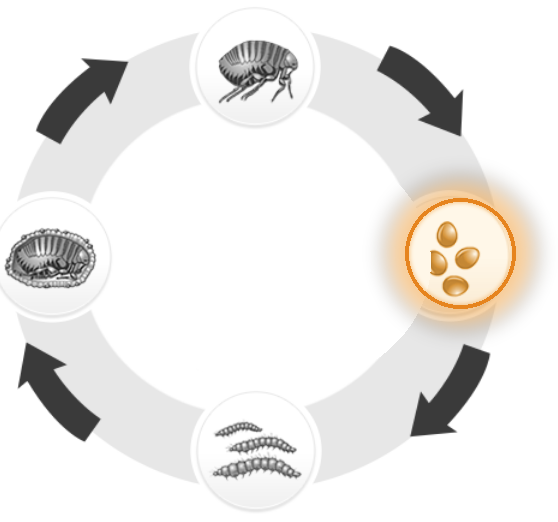
Eggs:
Large number of eggs (e.g., 40 to 50) laid every day. Fall off pet onto floor and furnishings. Hatch as larvae in as little as 1 to 10 days. 25% to 30% develop into adult fleas.
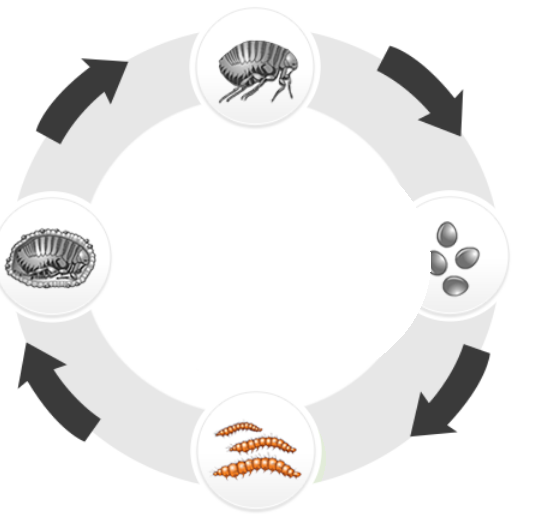
Larvae:
Thrive in warm, humid conditions. Hide deep in rugs and other furnishings and between floorboards. Feed on adult flea droppings (flea dirt) and other organic material such as skin debris that falls from dogs and cats.
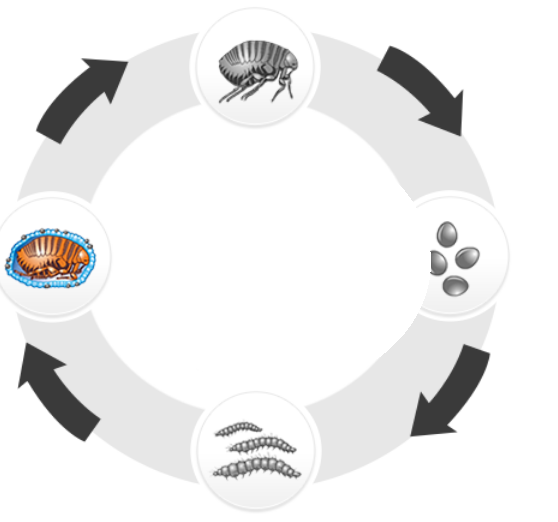
Pupae:
Develop (metamorphose) into adults inside tiny cocoons. Pupae can stay dormant for long periods inside these cocoons. Quite resistant to temperature, drying and insecticides. Emerge in response to heat, CO2 and movement.
Checklist – target flea hideouts!
- Help your pet break the flea life cycle with a flea treatment.
- Clean the house thoroughly on the same day.
- Wash all your pet’s bedding at a high temperature.
- Vacuum your carpets and furniture to remove eggs, larvae and pupae, and discard the vacuum cleaner bag.
By targeting all the hideouts at once, you help break the life cycle and keep your pet and home flea-free.
References
- Blagburn BL, Dryden MW. Biology, treatment, and control of flea and tick infestations. Vet Clin N Am Small Anim. 2009;39(6):1173-1200.
- Dryden M, Rust M. The cat flea: biology, ecology and control. Vet Parasitol. 1994;52(1-2):1-19.
Important Safety Information
BRAVECTO 1-MONTH (fluralaner) Chews: indicated for dogs 8 weeks of age and older. The most commonly reported adverse reactions include itching, diarrhea, vomiting, decreased appetite, elevated ALT, lethargy, and weight loss. BRAVECTO 1-MONTH (fluralaner) Chews is not effective against A. americanum in puppies less than 6 months of age. BRAVECTO (fluralaner) Chews: The most commonly reported adverse reactions include vomiting, lethargy, diarrhea, anorexia and pruritus. In some cases, adverse events have been reported following use in breeding females. BRAVECTO (fluralaner topical solution) for Dogs: The most commonly reported adverse reactions include vomiting, hair loss, diarrhea, lethargy, decreased appetite, and moist dermatitis/rash. BRAVECTO (fluralaner topical solution) for Cats: The most commonly reported adverse reactions include vomiting, itching, diarrhea, hair loss, decreased appetite, lethargy, and scabs/ulcerated lesions. BRAVECTO (fluralaner topical solution) for Cats is not effective against American dog ticks beyond 8 weeks of dosing. BRAVECTO PLUS (fluralaner and moxidectin topical solution) for Cats: The most commonly reported adverse reactions include vomiting, hair loss, itching, diarrhea, lethargy, dry skin, elevated ALT, and hypersalivation. BRAVECTO PLUS (fluralaner and moxidectin topical solution) has not been shown to be effective for 2 months in kittens less than 6 months of age. Use with caution in cats that are heartworm positive. The effectiveness of BRAVECTO PLUS (fluralaner and moxidectin topical solution) to prevent heartworm disease after bathing or water immersion has not been evaluated.
BRAVECTO (fluralaner) has not been shown to be effective for 12-weeks’ duration in puppies or kittens less than 6 months of age. BRAVECTO (fluralaner) Chews and Topical Solution for dogs is not effective against the lone star tick beyond 8 weeks of dosing. BRAVECTO (fluralaner topical solution) for Dogs and Cats and BRAVECTO PLUS (fluralaner and moxidectin topical solution) for cats are for topical use only. Avoid oral ingestion. The safety of BRAVECTO (fluralaner topical solution) for Cats and BRAVECTO PLUS (fluralaner and moxidectin topical solution) has not been established in breeding, pregnant, and lactating cats.
All BRAVECTO (fluralaner) products contain fluralaner, which is a member of the isoxazoline class. This class has been associated with neurologic adverse reactions including tremors, ataxia, and seizures. Seizures have been reported in dogs receiving isoxazoline class drugs, even in dogs without a history of seizures. Use with caution in dogs with a history of seizures or neurologic disorders. Neurologic adverse reactions have been reported in cats receiving isoxazoline class drugs, even in cats without a history of neurologic disorders. Use with caution in cats with a history of neurologic disorders.
Looking for a vet?
Your vet plays a big role in your pet’s health. Enter your location and get a list of vets near you.

In the spotlight
Wondering if your cat has fleas? Here are 9 telltale signs
What are the symptoms of fleas in cats, and how can you recognize them? Discover the 9 common signs of fleas in cats and learn how to get rid of them!
9 signs your cat has fleas
How can you tell if your cat has fleas? We’ll reveal the main symptoms so you can take the right steps to get rid of them.
Vaccination schedule for dogs & cats
Wondering what the cat vaccination schedule looks like? What are the most essential dog vaccines that your dog should get? Learn more here!
Canine ear infection: What is it and how is it treated?
Can you recognize the symptoms of ear infection in your dog? Find out by reading this article.
Fleas and ticks: is my pet at risk?
Your cat needs prompt attention if these parasites make an appearance.
Gastritis in cats
Symptoms, Causes, and Treatment of Gastritis in Cats
Everything you need to know about spaying your female dog
Sterilization of female dogs is one of the most widespread procedures for controlling unwanted litters and preventing certain pathologies such as mammary tumors and uterine infections.
The low-down on leptospirosis
One of the risks that have been increasingly reported in many countries worldwide that affects dogs is leptospirosis, also known as “lepto.”
Mange in cats: Everything you need to know
What is mange in cats, how is it transmitted, what is its treatment and how can you prevent it?