Health
10 questions about a dog’s anal glands
The anal glands are actually two small sacs located on either side of the anus, formed by an invagination of the skin.
Share the article:
1. What exactly are anal glands?
They communicate with the outside through a small duct that opens at the anus, at the border between the anal mucosa and the skin. The inside of these sacs is lined with many cells whose role is to secrete different substances that accumulate until they are expelled.
Finally, they are surrounded by a muscle that, when it contracts, allows the contents to be expelled outside the body, sometimes some distance from the animal.
When the anal sacs are full, they can be felt with the fingers on either side of the anus, roughly at the 4 o’clock and 8 o’clock positions if you imagine the anus as a clock face.
2. What do anal sacs actually contain?
The cells in the anal sacs produce different protein- or amino-acid-based substances, which they release inside the sac.
- Among these substances, some small amino-acid molecules are pheromones, which are essential for communication between animals of the same species. Their scent can only be detected by animals of that same species.
- Other molecules are also secreted and then transformed into very strong-smelling substances by bacteria that normally live in a dog’s anal sacs.
The appearance and consistency of these secretions also vary depending on their composition, but this does not necessarily indicate disease. They may be more or less liquid, thick, or paste-like, and may range in colour from creamy yellow to reddish brown. The secretions may also differ between the two anal sacs.
3. Why do these secretions smell so bad?
In order for a dog to detect pheromones, they must be mixed with another odourous secretion.
Once the dog detects this first very intense odour, they then use another specialized organ, the vomeronasal organ, to detect the pheromones and interpret all the information they contain.
The other purpose of the foul smell is purely “protective” and helps repel intruders.
4. What are anal sac pheromones used for?
Pheromones are a true communication system between animals of the same species.
“A pheromone is a chemical substance, or a group of chemical substances, released outside an individual’s body that, when received by an animal of the same species, triggers one or more specific reactions.”
This means they are only detected by animals of the same species. As a result, humans do not detect dog pheromones, and they are not what causes the foul smell of anal sac contents.
So when two dogs meet, they often start by sniffing each other’s rear end.
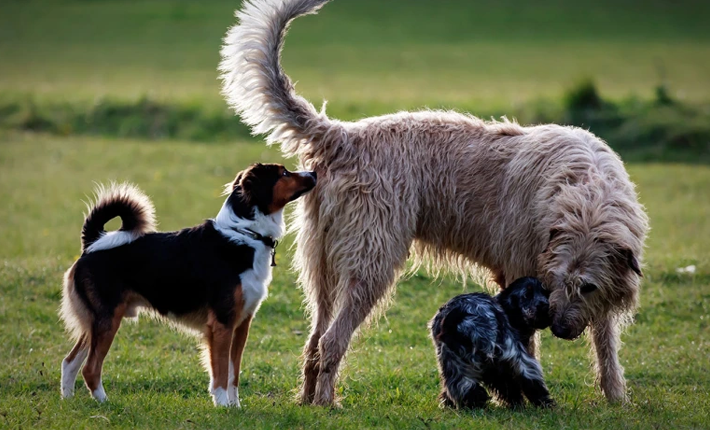
Similarly, during a walk, your dog may show great interest in faeces left by another dog.
- the species (this faeces does indeed belong to a dog; otherwise, the dog will not detect the pheromones left behind and will lose interest in it entirely)
- its age (pheromones differ among young puppies, adult dogs, and older dogs),
- its sex (they differ between females and males) and its sexual status (in particular, pheromones differ in females in heat),
- its social rank (dominant or not),
- its health,
- and its emotions. A very anxious dog may empty its anal sacs from a great distance to warn its neighbours of danger; upon detecting the scent, other dogs will take a detour to avoid the danger; this is seen very often at the veterinary clinic because very fearful dogs empty their anal sacs in the exam room, making it very difficult to bring in the next dog!
5. How often do dogs empty their anal sacs?
In fact, almost every time they pass stool. As stool passes through the anus, it compresses the anal sacs and releases a very small amount of secretion along with it.
This also explains why dogs are so interested in sniffing stool left by other dogs.
A dog may also release a larger amount of secretion by emptying their anal sacs separately and voluntarily.
6. Can dogs sometimes be unable to empty their anal sacs?
Yes. There are several possible reasons for this. It is called anal sac impaction. The sacs begin to swell because they fill with secretions that can no longer be emptied properly.
This causes itching around the anus. To relieve themselves and try to empty their anal sacs, dogs drag their rear end along the ground. This is the well-known “scooting” sign.
7. Why do anal sacs become blocked or engorged?
Most often, it happens because the secretions become thicker and more paste-like, making them unable to drain properly.
It is also possible for something to block the drainage duct, such as a segment of Dipylidium, a tapeworm transmitted by fleas, or a grass awn during the warm season.
Finally, certain skin diseases, such as seborrhoea or oily skin, can increase secretions.
8. Should a dog’s anal sacs be emptied regularly?
No. Dogs normally manage very well on their own. When the sacs are only slightly engorged, the dog may be able to empty them by scooting.
If you are unsure, or if you see your dog scooting repeatedly, do not hesitate to consult your veterinarian. The veterinarian will check the condition of the anal sacs, empty them if necessary, or perform other examinations.
9. Apart from impaction, are there other anal sac diseases?
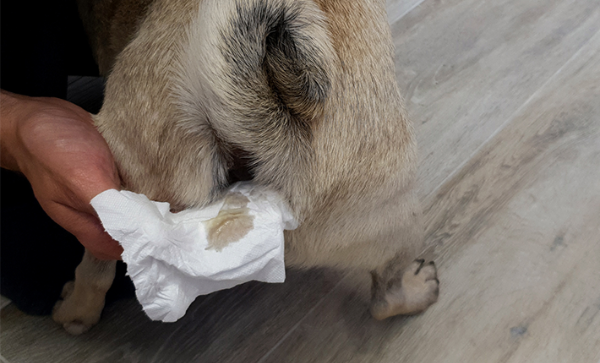
Yes. The sacs can become inflamed and infected, a condition called sacculitis. This is very painful for the dog and requires prompt treatment to stop the infection. A tumour may also develop.
It should be surgically removed, if possible before it becomes too large. If you notice that your dog often licks the anal area, has difficulty passing stool, or that the anal secretions become greenish, consult your veterinarian promptly.
10. If my dog scoots, is it always due to an anal sac problem?
Most often, yes, but not always. This sign indicates itching around the anus, which the dog tries to relieve by rubbing their rear end on the ground. The two main causes of this irritation are intestinal worms and anal sac impaction.
- the presence of intestinal worms: this is why it’s recommended to deworm your dog regularly to eliminate these infestations (ask your veterinarian for advice on the frequency of treatments based on your dog’s age and lifestyle);
- Anal sac impaction (or blockage). The contents, which are a bit too thick, do not flow out as easily when the dog defeacates, and rubbing against the ground helps compress the sacs to force their contents out (following the same principle as manual expression). However, it’s also possible that a foreign object has become lodged in the fur (especially in long-haired dogs), or that there is eczema or irritation of the anus that needs to be treated.
In all cases, repeated scooting should lead you to consult your veterinarian so the cause can be treated. Over time, these irritations may cause the animal to rub against hard surfaces, bite the anal area, and injure themselves.
If the anal sacs are very engorged or if the area around the anus is very irritated, this may also prevent the animal from passing stool properly, which requires making an appointment with your veterinarian promptly.
What about anal glands in cats?
Our feline companions also have anal glands, but diseases affecting these organs are extremely rare in cats, unlike in dogs.
Did you know?
Another animal, the skunk, has very well-developed anal sacs that can reach the size of a fist. They contain particularly foul-smelling substances, much stronger than those found in dogs.
Skunks are very skilled and, when they feel threatened, can easily spray the contents of their sacs both at a distance and upward.
These substances are so potent that they can cause severe digestive spasms in the intruder, giving the skunk time to escape.
Looking for a vet?
Your vet plays a big role in your pet’s health. Enter your location and get a list of vets near you.
In the spotlight
Wondering if your cat has fleas? Here are 9 telltale signs
What are the symptoms of fleas in cats, and how can you recognize them? Discover the 9 common signs of fleas in cats and learn how to get rid of them!
9 signs your cat has fleas
How can you tell if your cat has fleas? We’ll reveal the main symptoms so you can take the right steps to get rid of them.
Vaccination schedule for dogs & cats
Wondering what the cat vaccination schedule looks like? What are the most essential dog vaccines that your dog should get? Learn more here!
Canine ear infection: What is it and how is it treated?
Can you recognize the symptoms of ear infection in your dog? Find out by reading this article.
Fleas and ticks: is my pet at risk?
Your cat needs prompt attention if these parasites make an appearance.
Gastritis in cats
Symptoms, Causes, and Treatment of Gastritis in Cats
Everything you need to know about spaying your female dog
Sterilization of female dogs is one of the most widespread procedures for controlling unwanted litters and preventing certain pathologies such as mammary tumors and uterine infections.
The low-down on leptospirosis
One of the risks that have been increasingly reported in many countries worldwide that affects dogs is leptospirosis, also known as “lepto.”
Mange in cats: Everything you need to know
What is mange in cats, how is it transmitted, what is its treatment and how can you prevent it?